

McKinsey’s Cuts Signal a Broader Shift for Competitive Intelligence
In May 2025, McKinsey announced a 10% reduction across many internal functions—including strategy and intelligence roles.
This wasn’t just another round of belt-tightening. It was a signal.
Competitive Intelligence functions, once seen as essential, are now being questioned at the highest levels. These are high-cost, slow-output teams—often disconnected from decision velocity. And the core value they provide—turning noise into insight—is now being replicated by AI at scale, speed, and near-zero marginal cost.
Across industries, the uncomfortable question is gaining volume:
Do we still need a traditional Competitive intelligence team?
AI Is Commoditizing What Intelligence Teams Do
Let’s be blunt: most of what legacy competitive intelligence teams do today can be done faster—and often better—by machines.
Language models and retrieval systems can now:
- Scan 100,000+ documents in minutes
- Detect competitor and customer shifts in real time
- Summarize regulatory changes or thematic trends
- Generate board-level briefings instantly
One Fortune 100 VP put it plainly:
“The AI tells me what I used to ask my intel team. I don’t need the delay anymore.”
Tasks that once took an analyst 5 days now take a prompt and 10 seconds. And this isn’t the ceiling—it’s the new floor.
Survival Means Reinvention, Not Defense
The CI function isn’t dead. But the traditional form absolutely is.
You don’t survive this wave by defending legacy workflows.
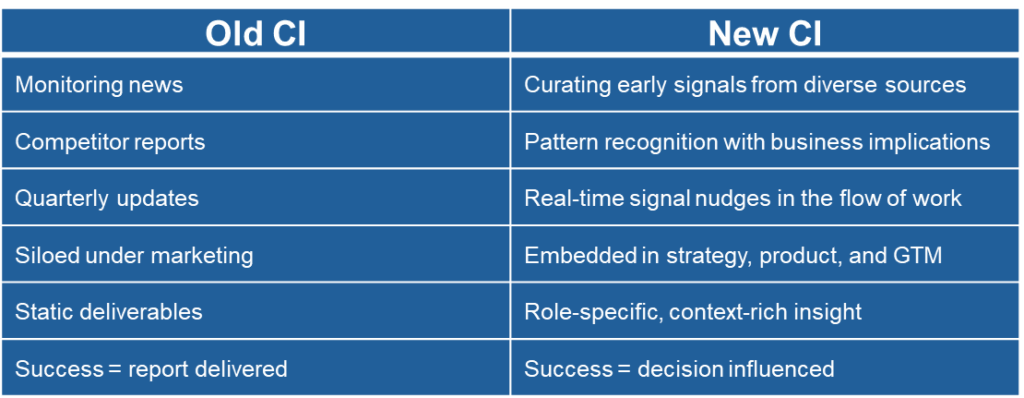
You survive by reimagining competitive intelligence as a strategic operating layer—always-on, AI-native, and outcome-driven.
Winning organizations are already:
- Embedding GPTs directly into CI workflows
- Automating signal detection across thousands of sources
- Replacing analysts with autonomous agents
- Upskilling remaining staff into insight orchestrators, not collectors
- Repositioning CI under GTM, strategy, or product—not buried in comms
| The shift isn’t about relevance. It’s about rearchitecture.
Strategic Competitive Intelligence in Action: A Tale of Two Teams
Let’s make this real.
A leading insurer announces its entry into voluntary benefits.
- Team A flags the press release, updates the battlecard, and sends a report.
- Team B saw it coming months earlier—via job postings, tone shifts in earnings calls, and product metadata changes.
Team B:
- Notified sales
- Informed product roadmap
- Repositioned messaging
- Armed leadership before anyone else reacted
Same signal.
One team reacted.
The other repositioned.
| That’s the difference between intelligence as a report and intelligence as a capability.
The Future of Competitive Intelligence
In Seeing What Others Don’t, cognitive psychologist Gary Klein reframes performance not just as error reduction, but as insight generation. In his words, great performance requires us to avoid mistakes and see what others miss.
That duality is precisely where competitive intelligence must operate.
Historically, CI focused on avoiding risk: spotting competitor moves, flagging threats, tracking changes. Valuable, yes—but mostly about minimizing surprises. The future, however, demands more. In a world flooded with information and shaped by nonlinear change, CI must become an engine for insight. It must enable companies to:
- Spot weak signals before they become obvious
- Detect shifts in tone, behavior, or strategy
- Challenge prevailing assumptions
- Reveal strategic opportunity in ambiguity
Klein observed that insights don’t arise from only more data—they come from seeing data differently. From connecting dots others ignore. From interpreting what’s unsaid, unexpected, or overlooked.
In other words, CI’s future isn’t just about having more signal—it’s about having the right lens.
This is the fundamental pivot:
- From reactive information tracking → to proactive insight generation
- From minimizing error → to maximizing perception
How to Build Strategic Competitive Intelligence: A Framework for Leaders
If you’re a head of CI or corporate strategy, the question is no longer “How do I defend the function?”
It’s: How do I transform it into something no business can live without?
Here’s a roadmap.
1. Rebuild CI as a Strategic Sensing System
- Move beyond formal channels. Build a real-time radar.
- Ingest signals from hiring, product copy, sentiment, and unscripted executive language
- Fuse structured and unstructured data
- Use AI to surface anomalies, early inflections, and market asymmetries
- Prioritize volatility over volume
- Simulate insights not with one framework, but many
Strategic CI starts with better perception—not better reports.
2. Own the Insight-to-Action Pipeline
- Don’t just deliver analysis—trigger action.
- Package insights for decisions, not documentation
- Run longitudinal views across quarters and product cycles
- Use business language: “Here’s the window,” “Here’s the risk,” “Here’s the bet”
- Deliver insight in the format that lands: Slack, voice notes, decision briefs
Insight only matters when it’s in motion.
3. Shift CI into the Flow of Work
- Get out of the inbox. Get into the meeting
- Integrate CI into GTM, pricing, product, and deal flows
- Tie intelligence delivery to strategic rituals—QBRs, roadmap planning, pipeline reviews
- Create “Insight Impact Reviews” with stakeholders to close the loop
The best intelligence arrives before it’s asked for.
4. Redefine the Metrics
- Stop tracking outputs. Start tracking influence.
- Measure decisions influenced, risks averted, speed-to-action
- Capture time-to-insight and time-to-decision
- Show how CI helped shift a narrative, reposition a launch, or avoid a misstep
The value of intelligence is what changes because of it.
The Strategic Choice Ahead
The question now isn’t whether intelligence is still needed.
It’s who gets to deliver it—and how fast.
Firms that modernize intelligence will move earlier, see clearer, and decide faster.
The rest will still be formatting decks while the market shifts under them.
Are intelligence functions dead?
Only the ones still defending the past.
About Bloom AI
Bloom AI delivers AI-native, integrated intelligence that helps financial firms move from data clutter to strategic action. We focus on the last mile of intelligence — turning fragmented data into timely, synthesized intelligence that business teams can act on proactively.
Unlike dashboards or static reports, our solutions & agents — SynthBI and DYSTL — proactively deliver plain-language intelligence directly into the workflows of sales, marketing, and research teams.
These teams rely on Bloom AI to surface sales signals, marketing performance shifts, and competitor movements — all in one streamlined layer. Our clients today include leading investment management firms, insurance, and private equity firms.
Firms use Bloom AI to cut through noise, speed up decisions, and unlock more value from the data they already have — without adding new dashboards, tools, or reporting overhead.
Bloom AI is a SOC II Type 2 certified firm located in Raleigh (N.C.) and Delhi (India).


